Acylated 7-O-glycosyl flavonoids from barley seedlings exhibit promising α-glucosidase inhibitory activity, but their efficient isolation remains a major challenge for bioactivity studies. In a recent study published in Food Chemistry (IF 9.8), researchers from the Chinese Academy of Sciences established a "Target-guided isolation workflow" integrating UPLC-QTOF-MS/MS, MPLC, HSCCC, and preparative HPLC to efficiently purify these bioactive compounds.
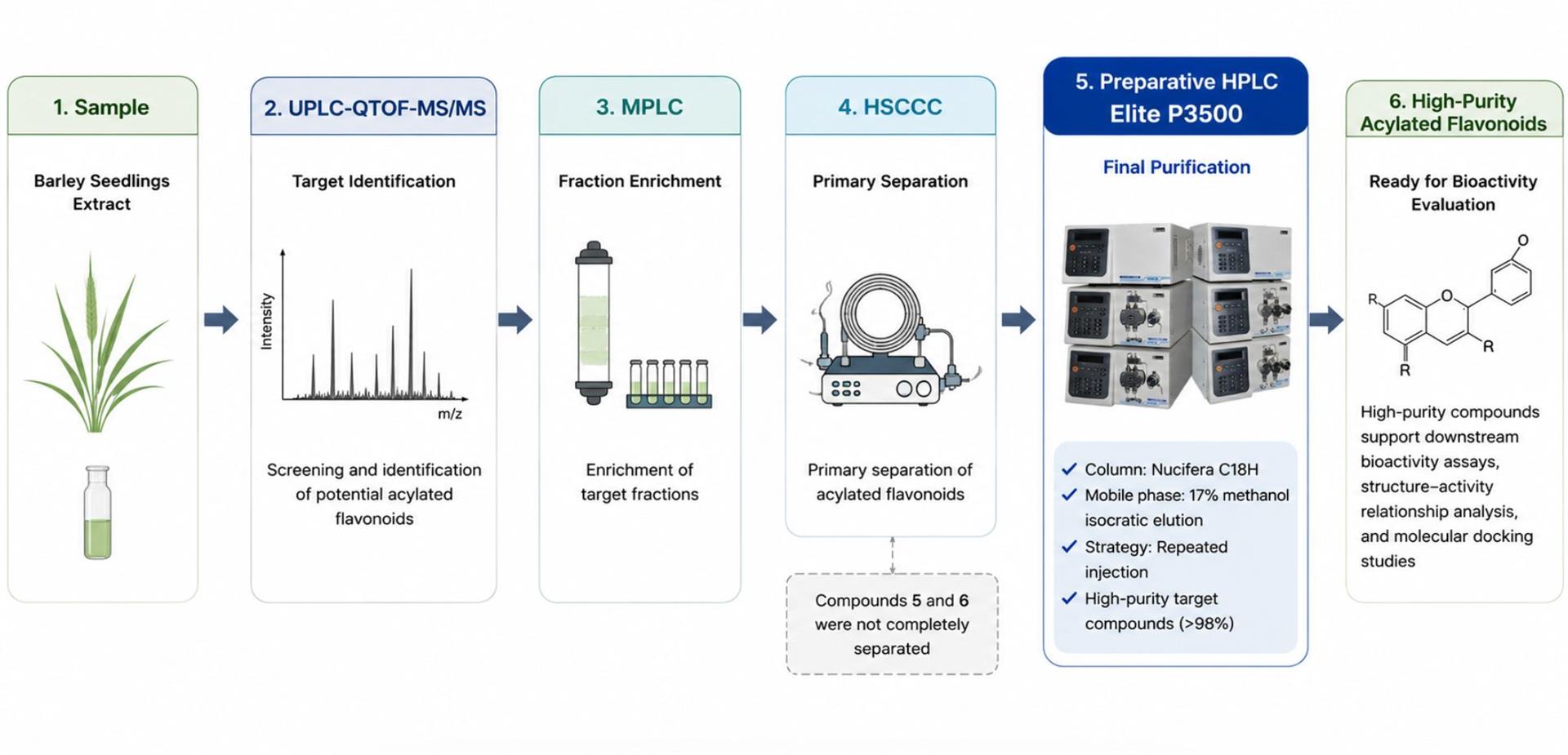
Following HSCCC separation, compounds 5 and 6 remained incompletely resolved. The researchers therefore employed the Elite P3500 preparative HPLC system for final purification. Using a Nucifera C18H column with 17% methanol under isocratic conditions, combined with a repeated-injection strategy, the Elite P3500 achieved baseline separation of the target compounds, yielding monomeric acylated flavonoids with purities exceeding 98%. This critical purification step enabled the researchers to accurately evaluate the inhibitory activity of each compound and establish structure–activity relationships, revealing that the acyl substituents followed the activity order of coumaroyl > feruloyl > hydroxybenzoyl > sinapoyl, while 5′-hydroxylation on the B-ring further enhanced α-glucosidase inhibition.
As a key purification step within this workflow, the Elite P3500 provided the high-purity compounds required for subsequent structure–activity relationship analysis and molecular docking studies. Filled the gap left by HSCCC in separating closely related polar analogues, made a substantial contribution to obtaining reliable activity data.
Paper Title: Effect of 7-O-glycosyl acylation of flavonoids from barley seedlings on α-glucosidase inhibition | Journal: Food Chemistry 488 (2025) 144891